
English 


Views: 0 Author: Site Editor Publish Time: 2026-05-17 Origin: Site


Modern manufacturing relies heavily on versatile polymers. They bridge the gap between high performance and tight budgets. Pvc film stands out as a true cornerstone material. You see it utilized across industrial, architectural, and packaging sectors. It offers a distinct balance of cost-efficiency, extreme durability, and chemical resistance.
However, you must choose the exact formulation for your needs. Your material choice directly impacts production yield and product safety compliance. It also influences your overall return on investment. Procurement teams must shift their focus today. You cannot simply ask what this material is. You must understand how to properly evaluate and specify it.
We will explore the diverse applications of different material grades below. You will learn how to evaluate formulations and navigate strict safety compliance. This guide helps you source the exact material your production line demands.
PVC film applications are dictated by plasticizer content, dividing the material into rigid packaging and signage grades and flexible furniture wrap or medical grades.
High chlorine content gives PVC natural flame retardancy and chemical resistance, but specific stabilizers, like Calcium-Zinc, are required for food or medical safety.
For packaging, PVC offers high clarity and low cost but faces strong competition from Polyolefin in automated, high-speed food applications.
Quality evaluation requires testing for uniform thickness, thermal stability, and specific processing compatibility, such as calendered film for high-end printing.
Procurement and engineering teams face a constant challenge. You must match material properties to specific environmental stressors. These properties include tensile strength, UV resistance, and thermal limits. Failing to match them correctly leads to premature product failure. Identifying the right application environment is your first step toward success.
Manufacturers use this material extensively on MDF boards, cabinets, and doors. It provides an excellent decorative and protective layer. These wraps require specific surface treatments. You often need high-gloss or matte finishes. They must feature UV-baked anti-scratch coatings to ensure long-term interior durability.
This polymer dominates the primary packaging sector. You will find it in blister packs and shrink-sleeve neckbands. It offers excellent dimensional stability. It also features a reliably low shrinkage threshold. This allows automated lines to seal products efficiently without excessive heat.
Industrial construction relies heavily on technical-grade films. Builders utilize them as waterproofing membranes and welding curtains. They also serve as electrical insulation tapes. Their non-conductive properties make them ideal for covering sensitive wiring.
Tip: If you manufacture curved or profiled cabinet doors, specify pvc film designed with adhesives for membrane presses. These machines rely on air and gas barriers to achieve seamless edge wrapping.
Industry | Primary Application | Critical Material Property |
|---|---|---|
Furniture & Decor | Cabinet and MDF door wraps | UV resistance and anti-scratch finish |
Packaging | Tamper-evident shrink bands | Dimensional stability and low shrink temp |
Construction | Electrical tapes and water membranes | High dielectric strength and waterproofing |
You must evaluate the fundamental mechanical properties of your material. The manufacturing process controls these properties directly. Suppliers add plasticizers during the extrusion or calendering process. The exact ratio dictates the final rigidity of the material.
This grade contains no plasticizers. It is highly durable and impact-resistant. It maintains superior structural integrity under pressure. Manufacturers find it ideal for clamshell packaging, ID cards, and point-of-purchase displays. However, you must watch out for specific risks. Lower impact toughness can lead to stress cracking. This often happens under extreme cold or sudden physical strain.
This grade contains significant amounts of plasticizers. High-quality producers use non-phthalate alternatives today. These additives help the material achieve extreme pliability. You see this grade used for shower curtains and inflatable structures. It also forms the base for high-quality synthetic leather.
This formulation strikes a delicate balance. It works best for applications requiring slight give without losing form. Examples include specific roofing membranes. You also see it in heavy-duty stationary covers. It provides structural support while resisting brittle fractures.
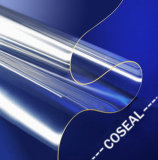
High-clarity PVC film rolls processed for flexible, commercial packaging and industrial applications.
Shrink and stretch packaging buyers frequently weigh different polymers. You must evaluate them based on cost, automation speed, and compliance. Selecting the wrong material can slow down your entire production line.
This polymer remains highly cost-effective. It offers brilliant clarity and shrinks at lower temperatures. It works best for non-food primary packaging. Common uses include wrapping CDs, software, and hardware. It also excels as tamper-evident banding on bottles.
This material features cross-linked polymer layers. This unique structure makes it highly durable. Regulatory bodies approve it for direct food contact. It is much better suited for high-speed automated packaging machines. You get superior seal strength and less machinery wear. The main drawback is the higher upfront material cost compared to chloride-based options.
This alternative focuses entirely on heavy-duty transit. You use it for secondary packaging tasks. Common applications include pallet stretch wrap and boat shrink wrap. It is not a direct competitor for high-clarity primary packaging.
Tip: Pay attention to your packaging machinery. If your production line experiences frequent seal-wire buildup, investigate your film. Transitioning to POF film can reduce machinery maintenance. It also eliminates the corrosive off-gassing associated with chloride films.
Feature | PVC | POF | PE |
|---|---|---|---|
Best Application | Tamper bands, non-food retail boxes | High-speed food packaging | Pallet wrapping, heavy transit |
Clarity | Excellent, high gloss | Excellent | Low to moderate, cloudy |
Food Safety | Requires special formulation | FDA approved by default | Generally approved |
Seal Strength | Moderate | Extremely high | High, stretch-focused |
Evaluating the chemical composition of your pvc film is critical. This process ensures regulatory compliance and operational safety. You cannot rely on physical appearance alone. You must dig into the underlying chemistry.
Heating this polymer during processing releases hydrochloric acid. This acid rapidly degrades the film. High-quality manufacturers use safe stabilizers to neutralize this chemical process. They use Calcium-Zinc stabilizers for food contact grades. They use Tin-based stabilizers to achieve high clarity. You must avoid suppliers who still use legacy lead stabilizers.
You can leverage the naturally high chlorine content of this material. This chemical makeup makes it inherently self-extinguishing. It is highly ignition-resistant compared to other plastics. This provides a major safety advantage over PE or POF. You will find this especially valuable in hazardous industrial environments.
B2B buyers need systematic steps to vet suppliers. You must validate material performance before committing to bulk purchasing. Follow this logic to ensure you acquire top-tier materials.
Define Environmental Stressors: Identify exactly what temperatures and chemicals the product will face.
Verify Manufacturing Methods: Ask the supplier how they process the polymer.
Request Compliance Documentation: Demand ISO, REACH, and FDA certificates upfront.
Conduct Factory Trials: Run a sample roll on your exact machinery.
You must specify calendered film for certain applications. This method utilizes heated rollers. It produces highly uniform thickness and a smooth surface. It works perfectly for high-fidelity printing and laminations. Alternatively, specify extruded or blown film if you need raw strength. Extrusion prioritizes biaxial tensile strength over perfect surface smoothness.
Odor: Pay close attention to the smell. A strong, pungent odor points to poor manufacturing. It often indicates the use of low-grade recycled resins or toxic solvents.
Visual Consistency: Unroll the material. Inspect sample rolls for color uniformity. Look closely for tiny pinholes. Check for consistent gloss levels. This is especially critical when inspecting furniture foil.
Flexibility: Test the material by hand. Check for brittleness. See if it tears easily along the grain. Poor tear resistance points to improper plasticizer ratios.
Note: Always request a 10-meter sample roll. Run this sample through your exact production equipment. Test it on your vacuum press or thermal sealer. You must verify adhesion, shrinkage rates, and thermal stability under actual factory conditions.
This polymer remains a highly versatile and cost-effective material. However, successful implementation relies heavily on your precision. You must specify the exact formulation your production demands. Carefully dictate the required rigidity, stabilizer types, and manufacturing methods.
Prioritize suppliers who offer transparent compliance documentation. Always look for partners who provide verifiable FDA, ISO, and REACH certificates. Finally, work with suppliers who offer strong technical support. They should assist you with machine calibration during your transition phase. Proper vetting ensures your production runs smoothly, safely, and profitably.
A: Yes, it responds exceptionally well to various sealing methods. You can process it using thermal, radio frequency, and ultrasonic sealing equipment. RF sealing is particularly effective for creating strong, airtight seams in industrial applications.
A: Generally no, unless it is explicitly formulated for it. You must ensure it uses FDA-approved, phthalate-free plasticizers and calcium-zinc stabilizers. For direct food contact, POF is often the safer, ready-to-use default material.
A: Extruded film pushes raw material through dies. It is highly cost-effective for standard packaging. Calendered film passes the material through a series of heated rollers. This produces highly uniform, smooth films ideal for high-end printing and architectural laminates.