
English 


Manufacturing Impact: Calendered PVC offers superior surface flatness and optical clarity compared to extruded alternatives.
Formulation Flexibility: The mechanical properties of PVC film—ranging from rigid to flexible—are determined by precise plasticizer ratios, allowing adaptation to diverse environmental stresses.
Inherent Safety: Composed of 57% chlorine, PVC naturally possesses self-extinguishing and flame-retardant properties vital for industrial compliance.
Application Specificity: While competitors like PET dominate food packaging, PVC remains the standard for heavy industrial barriers, medical device packaging, and specialized thermoforming.
To accurately evaluate this material, we must first understand its chemical foundation. We define PVC film as a versatile thermoplastic material. Manufacturers create it through the complex polymerization of vinyl chloride monomers. This robust chemical foundation yields a baseline material comprised of approximately 57% chlorine and 43% carbon.
Because it operates as a thermoplastic, you can repeatedly heat, shape, and cool the material. It accomplishes this without destroying its core molecular structure. Standard thickness ranges vary widely across the modern plastics industry. These ranges typically span from .003” for very thin applications up to ¼” for heavy-duty structural sheets.
To physically create the film, industrial manufacturers utilize two distinctly different production methods.
During calendering, raw plastic compound passes continuously through a series of massive, precision-heated rollers. These rollers apply immense pressure to flatten the plastic into a continuous sheet.
You gain massive quality advantages here. The outcome delivers highly uniform thickness across the entire web. It also produces exceptional optical clarity free from visual surface distortions. Furthermore, calendering gives manufacturers the unique ability to integrate in-line embossing. They can press custom textures directly into the hot film before cooling occurs.
Extrusion relies on completely melting the raw resin first. The machinery aggressively forces this molten plastic out through a specialized T-die. The hot film immediately travels over massive chill rolls. This drops its temperature rapidly to lock in the final shape.
Engineers often categorize this process into cast or blown extrusion lines. You will find this method incredibly useful for generating high-volume, cost-effective structural films. Extrusion pushes material out significantly faster than traditional calendering.
Note: Calendered PVC film is generally preferred in applications requiring high printability and exact gauge control, whereas extruded films are often selected for underlying structural layers where absolute optical clarity is secondary.
How does one foundational plastic successfully serve so many dramatically different industrial functions? The secret lies entirely in the formulation.
We engineer the specific physical behavior of PVC by carefully adding chemical agents known as plasticizers to the baseline resin. These highly effective additives actively shift the material from extremely brittle to highly pliable.
Rigid PVC contains absolutely zero plasticizers in its chemical formula. It aggressively retains its shape under heavy structural pressure. You benefit directly from extremely high dimensional stability.
This means the plastic will not warp or shrink unpredictably. Evaluators consider this specific grade highly ideal for producing durable thermoformed clamshells. It also performs perfectly for secure ID cards and robust rigid signage meant for long-term display.
This specialized option utilizes a distinctly low plasticizer content. It purposefully offers strong structural integrity while completely avoiding extreme brittleness.
You will find semi-rigid grades best suited for demanding outdoor banners. It also functions beautifully for complex graphic arts applications. Furthermore, builders rely on it to create moderately flexible waterproof membranes used in commercial roofing.
Here, manufacturers introduce a very high plasticizer content during the mixing phase. The material subsequently becomes highly capable of repeated folding, twisting, and wrapping.
It achieves this without ever suffering from material fatigue. Strict industrial guidelines frequently require flexible grades for critical items. These include medical IV bags, heavy-duty industrial shower curtains, and soft protective equipment covers.
Tip: When specifying film grade for cold-weather environments, verify the cold-crack threshold of your selected flexible PVC, as standard plasticizers can stiffen significantly below freezing temperatures.
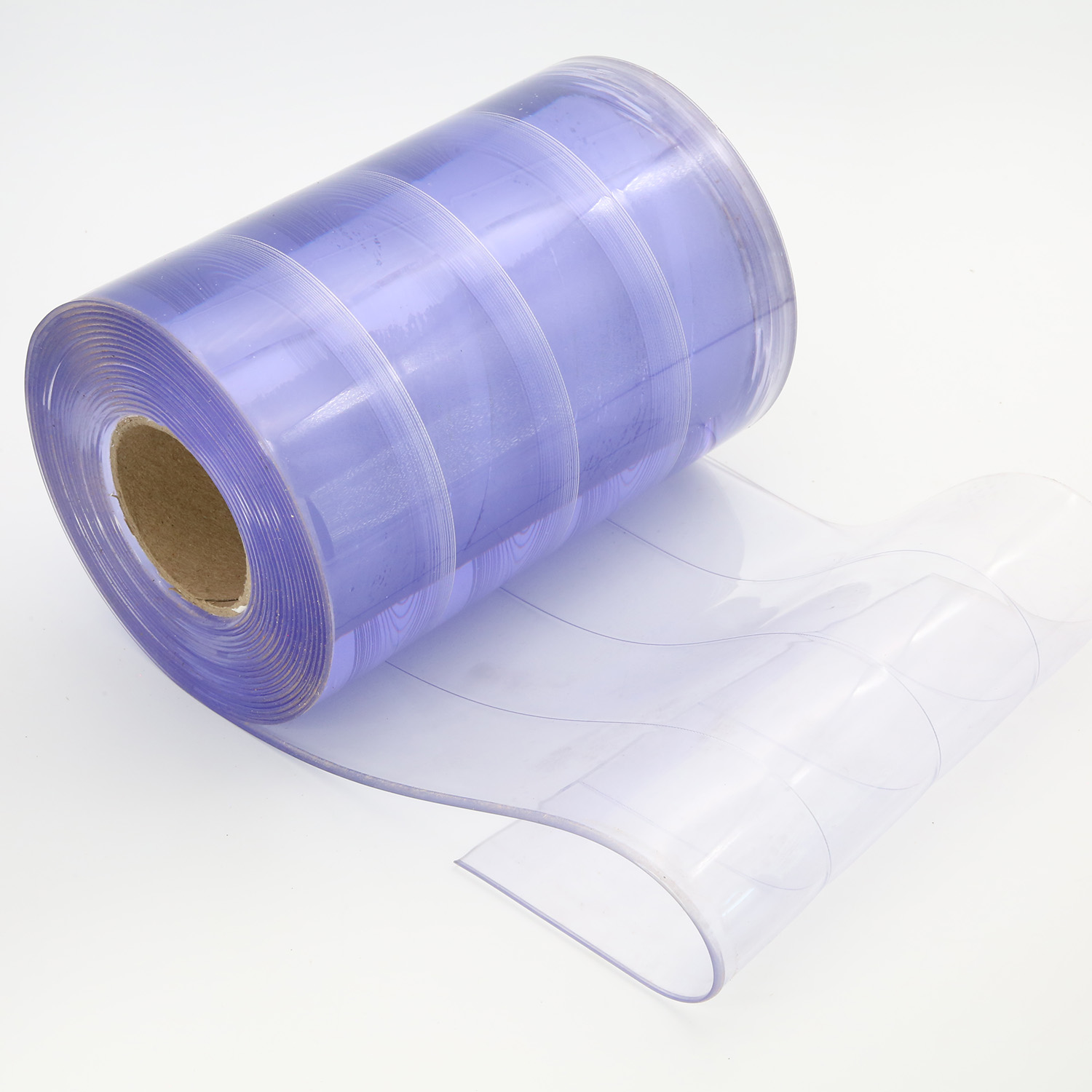
Clear, highly flexible PVC film manufactured for precise industrial and commercial applications.
Industrial buyers demand absolute reliability from their procured materials. They select this plastic because it delivers a unique combination of physical and chemical defenses.
The material easily withstands severe punctures, heavy scraping, and constant abrasions without shattering. Many rigid alternatives fail catastrophically upon hard physical impact.
If a sharp object pierces some competing plastics, the initial puncture rapidly leads to a massive structural web crack. PVC safely isolates the immediate damage. It yields safely around the puncture site, keeping the surrounding material structure completely intact.
You can fully rely on its proven non-reactivity to harsh petroleum oils, strong acids, alkaline solutions, and standard industrial surface cleaners.
This impressive chemical inertness makes it an incredibly reliable moisture barrier. Industrial facilities utilize it heavily to seal out highly corrosive environmental elements.
You must evaluate the key processing data carefully. You will note a softening point typically between 80–85°C. You will also observe a general melting point around 70°C.
These unique thermal thresholds make the material highly responsive to rapid heat sealing machinery. Furthermore, the molecular structure responds perfectly to RF welding. This specific process allows for instant, airtight, and completely seamless structural bonds.
Safety remains absolutely paramount in heavy industrial settings. The inherently high chlorine content naturally provides crucial self-extinguishing properties.
Additionally, the material acts as a robust, entirely non-conductive barrier. You can safely deploy it for critical electrical isolation or complex heavy machinery insulation.
Purchasing teams frequently compare this material against PET. You must closely evaluate both physical mechanics and baseline economics to make an informed choice.
Current market economics show an initial price gap between the two substrates. PET is currently about 20% cheaper by weight than standard vinyl alternatives.
However, PVC offers highly specific processing advantages during secondary manufacturing. These secondary processing benefits can often easily offset the higher raw material costs.
PET provides much higher baseline tensile strength. It inherently acts as a stronger physical barrier against moisture vapor and oxygen penetration.
Conversely, PVC provides vastly superior physical ductility. It will physically yield and stretch safely under sudden local impact rather than suddenly cracking.
PET boasts distinctly higher thermal conductivity across its surface. This specific physical trait results in noticeably shorter heating cycle times.
Consequently, you experience much lower total energy consumption during extensive thermoforming production runs.
You must clearly separate the specific use cases for each plastic to ensure compliance. PET acts as a highly chemically inert substrate. Therefore, it absolutely dominates FDA-approved direct food contact scenarios.
Polyvinyl formulations remain strictly limited in food applications. Instead, they heavily excel in specialized high-shrink packaging, massive industrial tank liners, and customized assemblies requiring heavy RF welding.
Evaluation Metric | PVC Film Profile | PET Film Profile |
|---|---|---|
Baseline Cost | Raw cost slightly higher, but offset by easier processing yields. | Currently sits about 20% cheaper by total weight. |
Mechanical Strength | Superior ductility; stretches and yields under local impact. | Higher tensile strength; stronger vapor and oxygen barrier. |
Thermoforming Energy | Requires slightly more energy due to lower thermal conductivity. | Shorter cycle times and lower energy consumption overall. |
Primary Application | High-shrink wrap, tank liners, RF-welded components. | FDA-approved direct food contact, beverage bottles. |
Tip: If your production line relies heavily on RF welding for sealing edges, specify PVC film over PET, as PVC’s dielectric properties respond instantly to RF fields for a flawless, permanent weld.
Industrial sectors actively leverage these unique chemical traits to solve demanding engineering problems. You will routinely find this exact material deployed across highly regulated, extreme environments.
In extreme industrial environments, long-term physical durability means everything.
Corrosive chemical tank liners: Thick calendered sheets aggressively block hazardous chemical seepage into the surrounding environment.
Heavy-duty welding curtains: Factories hang these tinted safety barriers to protect surrounding workers from hazardous sparks and dangerous UV light flashes.
High-visibility flexible window partitions: Builders use them extensively to create transparent, weather-resistant enclosures for demanding marine applications or complex architectural tents.
The healthcare field relies entirely on absolute material consistency and safety.
TPN bags: Highly flexible medical grades provide safe, sterile fluid containment for critical intravenous feeding.
Compression pads: They offer highly reliable, sustained pressure without the catastrophic risk of unexpected material bursting.
Sterile blister packaging: Rigid, completely unplasticized formulations heavily protect sensitive pharmaceutical tablets and specialized medical devices.
Visual appeal and physical tamper protection heavily drive the commercial packaging sector.
Tamper-evident shrink bands: Brands use heat-reactive formulations to tightly secure consumer products effectively.
Bookbinding covers: High-quality transparent sheets routinely meet strict BIA standards for visual clarity and tear resistance.
The global plastics industry continues shifting aggressively toward much greener production practices. Forward-thinking manufacturers now heavily favor advanced lead-free stabilizers.
Furthermore, we see a rapidly growing infrastructure dedicated exclusively to recycling industrial plastic waste. Processing facilities actively collect and convert this scrap into valuable secondary products like heavy-duty piping and resilient commercial flooring.
Selecting the correct film hinges entirely on navigating a precise decision-making matrix. You must meticulously match the specific plasticizer ratio to your exact structural needs. You must also align the chosen manufacturing method—whether calendered or extruded—directly with your baseline aesthetic and optical requirements.
To move forward with procurement successfully, follow these actionable next steps. First, clearly define your complete operating environment, heavily noting expected temperature extremes and any potential chemical exposure. Next, formally request detailed material data sheets from your supplier to carefully verify all thermal processing thresholds.
Finally, procure limited sample rolls. You should conduct your own prototype RF welding or thermoforming trials to guarantee flawless integration into your existing production lines. For projects requiring customized PVC film solutions, buyers can visit Qingdao Coseal to learn more about its product capability and company background.
A: Yes, PVC film is highly responsive to both heat sealing and Radio Frequency welding due to its thermal properties and dielectric constant, creating airtight, waterproof seams.
A: Specific, unplasticized, and heavily regulated formulations of clear PVC are FDA-compliant for certain pharmaceutical blister packs and medical devices. However, it is generally avoided for direct food contact packaging, where PET is the standard.
A: Calendered PVC is pressed through heated rollers, resulting in superior surface smoothness, uniform thickness, and high optical clarity. Extruded PVC is pushed through a die, which is faster and highly cost-effective but may exhibit minor surface imperfections compared to calendered film.
A: No. Because its chemical structure contains roughly 57% chlorine, PVC film is naturally flame retardant and self-extinguishing, meaning it will not continue to burn once the direct flame source is removed.